Folding vs Fixed Crutches: Freight Math and Price Bands
Two crutches can cost the same to make and land far apart on freight. The carton arithmetic, the parcel limit, and the price band each build fits.
What this note covers
Two crutches can cost the same to make and land far apart on freight. The carton arithmetic, the parcel limit, and the price band each build fits.
Covers: folding crutch wholesale · fixed crutch supplier China · crutch freight cost per unit · underarm crutch manufacturer · elbow crutch OEM
Key figures at a glance
If you are sourcing crutches and deciding between a folding and a fixed build, the answer is not “folding ships cheaper” — it is that the two builds fail in different places. A folding crutch costs more to make and less to move. A fixed crutch costs less to make and, in a parcel channel, can be close to unsellable. Between those two facts sits the whole decision, and most buyers only look at one of them.
This is the arithmetic we use when a distributor asks which build to put in a first order. It applies to elbow crutches and underarm crutches alike, and it is the same logic we use for folding versus fixed canes, because the trade-off is identical: geometry against parts count.
What “fixed” and “folding” actually change
Start with what does not change, because it is most of the product. A crutch is a tube, a grip, a cuff or underarm pad, and a foot. The load rating, the tube wall, the pad material and the tip compound are specification decisions you make either way.
What changes is the joint. A fixed crutch is one continuous structure, adjustable by telescoping at most, and there is nothing to loosen. A folding crutch adds a hinge or a twist-lock and one more tube section, and it collapses to roughly a third of its working length — 57 cm on our folding elbow crutches, which then cover 70–100 cm of height in twelve settings.
That one number, 57 cm, is the whole commercial argument for folding, and it has nothing to do with the hinge.
The freight arithmetic: volume, not weight
Crutches are light. A single aluminium folding crutch is about 770 g, the carbon fibre version about 520 g, and our LM4201 axillary crutch runs 1.54 kg in size S to 1.76 kg in size L. Freight is never charged on those numbers unless the carton is small enough that actual weight exceeds volumetric weight.
Two formulas matter:
- Volumetric weight. Most parcel carriers divide length × width × height in centimetres by 5,000 to get a billable kilogram figure; some use 6,000. Air freight uses 6,000 or 167 kg per cubic metre. A carton is always billed on the greater of actual and volumetric weight.
- Container volume. A 40-foot high cube holds roughly 68 m³ of usable carton volume after pallets and load inefficiency.
So the number you are really buying is cubic metres per unit. Take a one-piece underarm crutch in a 130 × 18 × 16 cm carton: 37,440 cm³, or 0.0374 m³, with a volumetric weight of 7.5 kg at a 5,000 divisor. Take a folding pair in a 62 × 22 × 14 cm carton: 19,096 cm³, or 0.019 m³, volumetric weight 3.8 kg.
Those figures are illustrative — substitute your own carton data, which is exactly what you should be asking the factory for. But the ratio holds across the category: folding is roughly half the cube of fixed, and on a container that halves per-unit ocean freight. On a $2,800 ocean leg into a 68 m³ container, that is about $41 per cubic metre, which puts the fixed crutch near $1.55 per unit and the folding near $0.78. Real, but small.
The place where the gap becomes decisive is downstream, not at the port.
Why the 57 cm matters more than the 250 g
Parcel networks are built around a longest-side limit, commonly around 60 cm for standard handling, with surcharges or rejection past it. A folded crutch at 57 cm sits just inside that line and behaves like a normal parcel. A one-piece adjustable underarm crutch in a 100–140 cm carton does not: it is oversize, it is often moved to LTL, and it acquires handling charges that have nothing to do with its weight.
That difference lands in three places on your P&L:
- Fulfilment tier. FBA and third-party warehouses price on dimensional tiers. A carton that crosses a size tier pays more on every unit you will ever ship, not once.
- Returns. A returned folding crutch is a parcel that goes back in the post. A returned one-piece crutch is a freight leg, an inspection, and a unit that usually cannot be resold as new.
- Customer expectation. Someone buying online expects a box they can carry upstairs. A 1.3 m carton arrives as a delivery event.
This is why the packaging decision and the product decision cannot be made separately. A fixed crutch can be excellent product and still be the wrong product for an Amazon listing.
The cost the folding build adds back
Folding is not free. A hinge or twist-lock, an additional tube section and extra assembly time all raise unit cost, and the tooling for the lock and the cuff is real money. That is why the folding build sits in a higher price band, and why the price gap between builds is bigger than the freight gap.
The honest trade is this: the folding build costs more per unit at the factory and less per unit in motion. At a few hundred units the factory cost dominates. At container scale into a parcel-driven channel, the freight and returns line overtakes it.
There is a third build in the middle that buyers often miss. The carbon fibre folding elbow crutch is the same 136 kg rating and the same 57 cm folded length, at 520 g instead of 770 g. That weight difference does not change container economics — it changes parcel economics at the margin, and it changes what the product can be sold as. We covered the material split separately in carbon fibre versus aluminium folding crutches; treat that as the second decision, after you have chosen fixed or folding.
Which price band should carry which build
Match the build to the shelf, not to the brochure.
Entry band — fixed aluminium underarm. Institutional buyers, hospital discharge, pharmacy chains, rental fleets. The product is bought in size runs, replaced on a schedule, and nobody pays a premium for a hinge. Here the fixed build wins on unit cost and on durability, and the three-size structure of the LM4201 is an advantage rather than a burden, because institutional buyers hold depth anyway. Margin is thin; the volume is in repeat orders.
Mid band — folding aluminium elbow. Retail, marketplaces, DTC, homecare distributors selling to individuals. One SKU covers most of the adult population, the carton is a parcel, and the freestanding quad base is a listed feature the buyer can photograph. This is the build that carries a 4–5× multiple comfortably, for the reasons set out in our wholesale margin breakdown.
Premium band — carbon fibre folding, and printed shafts. Buyers differentiating on weight, on finish, or on a design story. The 3D textured print on the YMX4202DJ series exists because a sprayed shaft that gets scuffed in a parcel looks like a returned product, while a pattern formed into the surface does not show a rub mark the same way.
The awkward one — fixed underarm with a wide frame. The YMX4209 adds a trapezoidal frame and drawer storage. It is a good institutional product and a poor parcel product, and no amount of marketing fixes a carton that big. Sell it where it is delivered on a pallet.
How to split a first order
If you cannot decide, do not decide. A mixed trial is designed for exactly this: $2,000 of order value, models mixed, 7–10 days lead time from confirmed artwork. Put two thirds into the build your channel most likely sells and one third into the other, then watch the reorder rate rather than the first sell-through — first orders sell because they are new on the shelf, reorders sell because the product worked.
Two operational notes from our own line. First, cuffs, straps, tips and locks are interchangeable across the folding range, so one listing family can run on one spare-parts pool; that is a real cost saving and worth asking about explicitly. Second, certificates travel with the product, not the build: ISO 9001 certificate 8629985173 and ISO 13485 certificate 8623138319, both valid to 18 June 2028, plus FDA establishment registration 3014264913 and CE EMC certificate FCS202503711CA01 for the walking-stick series, are issued to the plant — Guangdong Jinda Health Care, in the trade since 2010, this plant since 2017. You will need them whichever crutch you order, so verify them before you compare prices. The certifications page lists the numbers with the issuing bodies.
The five numbers to ask for before you choose
Before any quotation is comparable, ask for these, per build, per SKU:
- Packed carton dimensions, in centimetres, with the carton closed.
- Gross weight per carton and units per carton.
- Cubic metres per unit, which is the first two numbers divided out — make the supplier do it and check the arithmetic.
- Longest side, so you can test it against your parcel network’s limit.
- Spare-parts availability for the lock, the cuff and the tips, because that is what decides whether a return becomes a repair or a write-off.
With those five numbers you can price any crutch into any channel in about ten minutes. Without them, the factory price is a number that tells you nothing about what the product will cost you — which is the mistake that makes a cheap crutch expensive and an expensive one profitable.
Frequently asked questions
- Is a folding crutch more expensive to ship than a fixed crutch?
- Per unit in a container, usually yes in cost but no in cost per dollar of product. A folding crutch packs into a carton roughly half the volume of a one-piece crutch, so its per-unit container freight is lower. What costs more is the product itself: a hinge or twist-lock, an extra tube section and a folding mechanism add parts and assembly time. In a parcel network the gap widens further, because a one-piece crutch over about 60 cm leaves standard parcel handling and gets billed on length or moved to LTL.
- Can I ship fixed crutches by parcel at all?
- An adjustable underarm crutch typically packs to 100–140 cm depending on how far it collapses. That is past most parcel networks' longest-side limits, so those cartons either go as oversize parcels with a length surcharge or move on a pallet as LTL freight. If your channel is e-commerce with courier delivery, this single dimension decides whether the product is viable at all.
- How many SKUs does each build force me to carry?
- This is the cost buyers forget. A fixed three-size underarm crutch means three SKUs per colour, and a user who does not fit the middle size is a return or a lost sale. A twelve-level folding crutch covers 70–100 cm in one SKU, so a single listing serves most of the adult population. Fewer SKUs means less safety stock, less shelf space and less dead inventory at the end of a season.
- Does folding mean weaker?
- Not if the lock is specified properly. Our folding elbow crutches are rated to 136 kg, the same as the carbon fibre version, and the failure mode buyers actually see is play developing in the lock, not the tube failing. That is a tooling and assembly question: a rotary twist-lock that is fatigue-tested well past the medical-device standard behaves differently from a pin-and-socket catch after six months of daily use.
How to apply this to your order
- Get the packed carton dimensions, gross weight and units per carton for both builds before you compare landed cost — the factory price tells you nothing about freight.
- Work out cost per unit of carton volume, not cost per unit of weight. Crutches are light; volume is what you are paying for.
- Check the longest carton side against the parcel limits of your fulfilment channel. A 130 cm carton is not a parcel, whatever the rate card says.
- Split the first order across both builds and let the reorder tell you which one your channel actually sells; a $2,000 mixed trial is enough to see it.
Models this note applies to
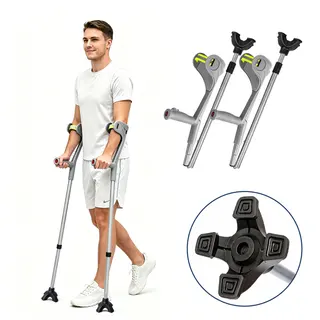
YMX4202AJ
Folding elbow crutch, 12-level height adjustment, self-standing quad base
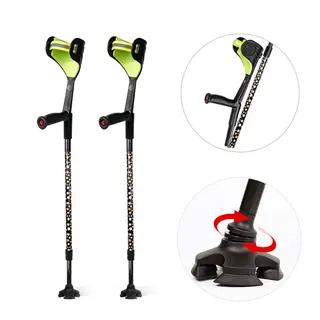
YMX4202DJ
3D textured print shaft, twist-lock folding, 360° rotating foot pad
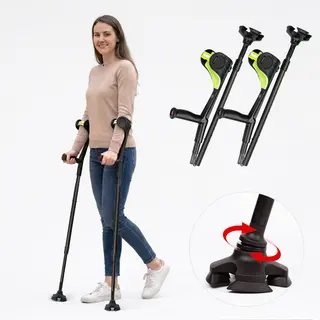
YMX4401TD-S
Carbon fibre tube, twist-lock folding, night-safe reflective strap

LM4201
Thickened aluminium alloy axillary crutch in three sizes, ten-level height adjustment and a stepped TPR underarm pad
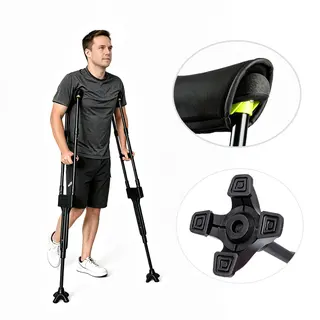
YMX4209
Trapezoidal frame underarm crutch with drawer storage and 9-level height adjustment
Related notes
Price this against your market
Send the category, the market and the quantity band. We reply with material options, MOQ per SKU, lead time and the certificates your market needs.