EU Market Access for Mobility Aids: MDR, UKCA, CE
A CE certificate under the EMC directive is not an MDR file, and UKCA is not a copy of CE. What EU and UK buyers should actually ask a factory for.
What this note covers
A CE certificate under the EMC directive is not an MDR file, and UKCA is not a copy of CE. What EU and UK buyers should actually ask a factory for.
Covers: EU MDR compliance mobility aids · CE marking rehab equipment · UKCA medical device requirements · Class I medical device self declaration · EU importer requirements medical devices · CE certificate China factory
Key figures at a glance
If you are sourcing mobility aids for Europe, the first thing to separate is CE marking, MDR compliance and UKCA — they are three different questions, and a factory that emails you “our CE certificate” for a walking stick has usually sent an EMC test certificate, not a medical device file. That single confusion is behind most of the compliance arguments that surface at the port, or three weeks after the retailer’s QA team opens the first carton.
This is written from the factory side of that conversation, because the mistakes are made on both sides. Buyers ask for the wrong document and then reject a supplier who is actually compliant; suppliers send the document they happen to have and let the buyer assume it covers everything. Neither is dishonest, and both are expensive.
CE is a mark, not a certificate — and it can be earned under the wrong directive
The letters CE do not name a law. They are affixed under whichever EU directive or regulation applies to the product: electromagnetic compatibility (2014/30/EU), low voltage, machinery, toys, pressure equipment, medical devices (2017/745). A product can carry a perfectly lawful CE mark for EMC and still be nowhere near compliant as a medical device.
That is not a loophole, it is just how the framework works, and it is why the directive number on the document matters more than the certificate’s layout. Look for 2017/745 — the Medical Device Regulation, applicable since 26 May 2021. If the paper in front of you cites only 2014/30/EU, it is telling you the electronics do not interfere with other electronics. It is not telling you the product may be placed on the market as a medical device.
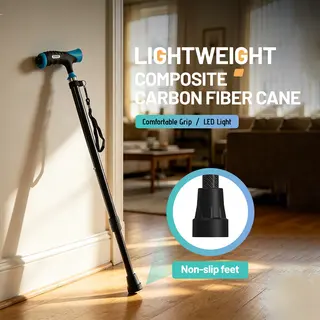
For reference, our own CE documentation is exactly that narrower kind: certificate FCS202503711CA01 under the EMC Directive, backed by test report FCS202503711E01 from Dongguan Funas Testing Technology, and scoped to the LM4904 walking-stick series — one product family, not the catalogue. It is a real document and it is verifiable with the laboratory. It is not an MDR certificate, and we do not present it as one. You can see the full scope line on the certifications page, which is deliberate: a scope that is written down can be checked, and a scope that is implied cannot.
MDR Class I: who actually signs the paperwork
Here is the part that surprises buyers most. For most of this category — commode chairs, shower chairs, toilet safety rails, canes, crutches, walkers — the device is Class I under Annex VIII of the MDR: non-invasive, not sterile, no measuring function.
Class I devices that are not sterile and not measuring are self-declared. There is no notified body in the chain and therefore no notified body certificate. What exists instead is a set of documents the manufacturer builds and signs:
- Technical documentation per Annex II and III — design, materials, biocompatibility reasoning, risk management file, verification and validation, labelling.
- EU Declaration of Conformity per Annex IV — the legal act. It names the manufacturer, the device, the class, the regulation, the standards applied, the signatory and the date.
- A quality system the manufacturer is audited against. For us that is ISO 13485, certificate 8623138319, valid to 18 Jun 2028, alongside ISO 9001 certificate 8629985173.
- Post-market surveillance and vigilance procedures, which is the part buyers forget to ask about until something goes wrong.
The distinction that catches people: Class Is (sterile) and Class Im (measuring) are not self-declarable, and neither is anything from IIa upward. A commode chair with an integrated scale is a measuring device and drops straight out of the self-declaration route. Same chair, different configuration, completely different compliance path — which is why “is this model CE marked?” is a weaker question than “which class is this exact configuration, and who signed the declaration?”
The other reason this matters commercially: a supplier who cannot produce a Declaration of Conformity for a specific model probably has not built the technical file behind it. The DoC is the visible tip. The file is the work.
What your importer is legally on the hook for
Under the MDR the importer is not a passive reseller. Article 13 puts obligations on them directly: verify the CE mark and the Declaration of Conformity, verify the manufacturer is registered, ensure the label carries their own name and address, keep a copy of the DoC and make the technical documentation available to authorities on request. Distributors have a lighter but real set under Article 14 — check the mark, the DoC and the language of the instructions.
This is why a competent EU importer will ask you for a document pack rather than a single PDF, and why a supplier who has never been asked before will answer with “we have CE” and stall. If you are the importer, the pack is not a negotiation tactic; it is the evidence you would have to produce if a market surveillance authority knocked.
UKCA: Great Britain stopped needing it for medical devices
The UKCA story is widely misunderstood, including inside the UK. UKCA was introduced for the GB market (England, Scotland, Wales) after Brexit, but for medical devices the MHRA has said it will continue to accept CE marking indefinitely. UKCA is not currently required to place a medical device on the GB market.
What is required is a UK Responsible Person established in Great Britain, performing roughly the role the authorised representative plays in the EU. So when a UK distributor says “we need UKCA”, the practical answer is usually: you need a UK Responsible Person and a CE-marked device, and the UKCA mark is a future-proofing question rather than a present blocker.
Northern Ireland is the exception that proves the rule. Under the Windsor Framework it applies EU rules, so CE is the route there and UKCA was never the route. A single UK launch that treats England and Northern Ireland as one market will get the labelling wrong.
Treat all of the above as the position to verify, not a permanent fact — UK device regulation has been re-dated more than once. Confirm the current MHRA position before you print cartons, because printed cartons are where compliance decisions become non-refundable.
The five documents to request instead of “your CE certificate”
If you take one thing from this piece, take the list. Ask for these by model, not by company:
- EU Declaration of Conformity citing Regulation (EU) 2017/745, listing the exact model numbers it covers, with a signatory name and a date. A DoC that lists a series is fine; a DoC that lists “our products” is not.
- Technical documentation, or a documented index of it with revision numbers. You will rarely want the whole file, but you want to know it exists and is current.
- The written mandate of the authorised representative inside the EU, with a name and an address. Article 11 makes this mandatory for a non-EU manufacturer.
- The manufacturer’s registration in EUDAMED, i.e. the SRN, plus the UDI-DI for each model. Actor registration has been mandatory for some time; the device and UDI modules have been re-timed more than once, so check the Commission’s current EUDAMED status rather than a blog post — including this one.
- ISO 13485 certificate with the number and scope visible. Not a logo, not a badge on a homepage. The number, so it can be looked up.
Add the instruction manual in the language of the destination member state. Article 10(11) requires the instructions to be in a language accepted by that country, and it is the single most common finding in a first shipment. Nobody in the chain catches it — not the notified body, because there isn’t one for Class I; not customs, usually; not the factory’s own QC, because the factory cannot read twelve languages. It surfaces when the retailer’s QA opens the box.
Where a Class I file quietly fails: IFU language and UDI
Two failure modes account for most of the friction we see on Class I orders, and neither involves the product.
Language. A multilingual manual is a print job, and print jobs are cheap at volume and expensive at $2,000. The honest way to handle it is to settle the language set before the deposit, because the artwork proof cycle — not the printing — is what moves the ship date. We wrote about that cycle separately in the piece on packaging and manual localization, and the short version is: late artwork costs a week, late quantity costs a reschedule.
UDI. The UDI carrier has to be on the label, and for reusable devices also directly marked on the device. The Class I deadline has already passed (May 2025), so this is not a future requirement to defer — either the DI is in the file and printed, or the shipment is not compliant. It is also the field most likely to be missing from a supplier’s paperwork, because it lives in the label artwork rather than in the certificate folder.
Neither of these is a reason to avoid Class I sourcing. They are reasons to put them on the PO as line items with owners and dates, instead of discovering them at the carton stage.
What our own documents cover, and what they do not
Being precise about this is more useful to you than a wall of logos.
We hold: CE under the EMC Directive, certificate FCS202503711CA01, scoped to the LM4904 walking-stick series — see the canes range and the LM4904 model page. ISO 13485 certificate 8623138319 and ISO 9001 certificate 8629985173, both valid to 18 Jun 2028, covering design, production and servicing of rehabilitation and nursing products. A US FDA establishment registration, 3014264913, renewed 15 Sep 2025. And a Registered Community Design, 015131494-0001, registered with EUIPO on 27 Jan 2026 — that one protects the appearance of a mould, and it is worth knowing about because it is the answer to “is this a copy of a European product?” It is not a compliance document, and we do not count it as one.
We do not hold: a notified body certificate under the MDR, because for Class I non-sterile, non-measuring devices there is no such certificate to hold. If your market or your customer requires a full MDR technical file for a specific model — including the authorised representative, EUDAMED device registration and UDI assignment — that is a project with its own scope, cost and calendar. Ask for it as a project. A supplier who says “yes, we will email it tomorrow” has either misunderstood the question or is about to send you an EMC certificate with a new filename.
That is also why the honest sequencing for a first EU order is: pick the models, confirm the class of the exact configuration, then decide whether you need the self-declaration route or a notified-body route. Doing it the other way round — buy the container, then ask — is how buyers end up with stock they cannot legally list.
A pre-RFQ checklist you can actually run
Five questions, in this order. The answers tell you whether the supplier is compliant or merely confident.
- Which directive is the CE under? The answer must be 2017/745 for a medical device. Anything else is a different question being answered.
- Self-declared or notified body, and which class? Class, not “CE”, decides the document set. A configuration change can change the class.
- Can you send the Declaration of Conformity for these exact models? If it lists models you did not ask about, read the list.
- Who is your authorised representative in the EU, and can I see the mandate? A name and an address, in writing.
- What is the UDI-DI, and which languages are on the manual? Both belong on the PO, not in a follow-up email.
Our order terms — $2,000 minimum measured on order value with models mixable, T/T or Trade Assurance, 7–10 days production on stock frames — are on the MOQ and pricing page, and the factory itself is on the factory page if you want to see where the ISO 13485 audit applies. If you are also shipping to the United States, the FDA and state-level piece covers the parallel route, and the ISO 13485 vs ISO 9001 comparison explains why the QMS number is the one worth looking up rather than the badge.
None of this is exotic. It is a document set, a class determination and a language list — three things that cost almost nothing when they are decided before the PO and a great deal when they are discovered after the container is booked.
Frequently asked questions
- Does a CE certificate mean my commode chair can be sold in Germany?
- Not on its own. CE is a mark that can be affixed under a dozen different directives. If the certificate you were sent cites 2014/30/EU (electromagnetic compatibility) or 2006/42/EC (machinery), it says nothing about the Medical Device Regulation 2017/745, which is the route a commode chair needs in the EU. Ask which directive the CE is under before you accept the document.
- Do I need UKCA to sell mobility aids in Great Britain?
- For medical devices, no. The MHRA has said it will continue to accept CE marking in Great Britain indefinitely, so UKCA is not currently required for medical devices placed on the GB market. What you do need is a UK Responsible Person established in Great Britain. Northern Ireland is a separate case: it follows EU rules under the Windsor Framework, so CE applies there and UKCA never did.
- Who issues the CE certificate for a Class I medical device?
- Usually nobody, because there is no certificate. A Class I device that is not sterile and has no measuring function is self-declared: the manufacturer compiles the technical documentation, signs an EU Declaration of Conformity and affixes the mark. A notified body is only involved for Class Is, Class Im and Class IIa upwards. So a buyer asking a Class I supplier for "your CE certificate" is asking for a document that does not exist in that form — ask for the Declaration of Conformity instead.
- What does an EU importer need from a Chinese factory before the first shipment?
- Five things: the EU Declaration of Conformity for the exact models, the technical documentation (or a documented index of it), the written mandate of the authorised representative inside the EU, the manufacturer registration number in EUDAMED, and the ISO 13485 certificate with the number and scope visible. Add the UDI-DI per model and the instruction manual in the destination country language. Your name goes on the label as importer, so anything missing becomes your liability, not the factory’s.
What to fix before you request a quote
CE, MDR and UKCA are three different questions. Ask which directive the CE is under, and whether the route was self-declared or notified-body — the answer tells you whether the document in your inbox is worth anything.
How to apply this to your order
- Before you accept any CE document, read the directive number on it. 2017/745 is the medical device route; 2014/30/EU is EMC only.
- Ask for the EU Declaration of Conformity by model, not a certificate by company — a DoC lists the exact models it covers.
- Confirm in writing who your authorised representative is, with an address in the EU, and get the mandate document, not a promise.
- For Great Britain, plan a UK Responsible Person rather than a UKCA mark; for Northern Ireland, plan CE.
Where these figures come from
- Regulation (EU) 2017/745 on medical devices EUR-Lex, applicable since 26 May 2021
- ISO 13485 certificate 8623138319, ISO 9001 certificate 8629985173 Published on the site certifications page checked Valid to 18 Jun 2028
- CE EMC certificate FCS202503711CA01, test report FCS202503711E01 Dongguan Funas Testing Technology Co., Ltd. checked Issued 2025
- Registered Community Design 015131494-0001 EUIPO design register checked Registered 27 Jan 2026
Models this note applies to
Related notes
Price this against your market
Send the category, the market and the quantity band. We reply with material options, MOQ per SKU, lead time and the certificates your market needs.