OEM Packaging and Manual Localization: Where Returns Start
A product that is right but documented in the wrong language still returns. What to localize, what must never be translated, and how artwork moves lead time.
What this note covers
A product that is right but documented in the wrong language still returns. What to localize, what must never be translated, and how artwork moves lead time.
Covers: OEM packaging and instruction manual localization · private label instruction manual translation · medical device label requirements importer · multi language manual printing China · assistive device packaging artwork approval · rehab equipment private label
Key figures at a glance
A product that is built correctly and documented in the wrong language still comes back. OEM packaging and instruction manual localization is the step where a private-label order either becomes a sellable SKU or becomes a pallet of units that cannot be listed, and it is decided months before the first carton ships. The failure is rarely the translation itself. It is that nobody treated the manual, the label and the carton as one specification with the product, so three separate documents drifted out of alignment with each other and with the market they were going to.
This is the part of sourcing that does not show up in a sample photo. A sample arrives, the frame is right, the finish is right, the weld is clean. Nothing in that box tells you whether the warning on page four says the same thing as the sticker on the frame, or whether the importer block is blank because the buyer had not registered the brand yet when the artwork was approved.
The manual is a specification, not a translation task
Buyers tend to brief a manual as a translation job: here is the English text, give it back in French. That framing is what produces manuals that read correctly and assemble incorrectly.
A usable manual for an assistive device carries four different kinds of content, and they are not handled the same way.
Identifiers. Model code, certificate numbers, standard references, spare-part numbers. These are reproduced, never translated, never reformatted. A commode chair model code printed as YMX6108K on the carton, YMX 6108 K on the manual cover and 6108K on the invoice is three identifiers where there should be one, and the mismatch surfaces at customs or at the spare-parts desk.
Procedures. Assembly, adjustment, folding, cleaning, and the specific order in which those steps happen. This is where localization actually earns its cost, because a procedure is not a sentence — it is a sequence with a direction, and the direction has to survive the language change. A step that reads “insert the leg and rotate until it locks” translates cleanly. A step that reads “fit the leg to the frame” does not, and a translator working from the sentence alone will produce something that is grammatically perfect and mechanically ambiguous.
Warnings and contra-indications. Load limits, weight capacity, surfaces the device must not be used on, and the population it is not intended for. These must be consistent across the manual, the label on the product, and the carton. Buyers get caught when a manual is updated for a new load rating and the sticker on the frame is not, so the product ships carrying two different numbers.
Commercial content. Brand story, care instructions written for the end user, the “about us” paragraph. This is the only part where a translator has latitude, and it is the part buyers spend the most review time on.
Get the first three right and the fourth is cosmetic. Get the first three wrong and no amount of good copy repairs it.
What has to be translated, and what must be protected from translation
The practical rule is that anything a human reads gets translated and anything a machine, a customs officer or a warranty clerk reads does not.
Translate: assembly steps, adjustment ranges described in prose, cleaning and disinfection instructions, intended-use statements, warnings, the troubleshooting table, and the warranty terms the end user is meant to act on.
Do not translate: model codes, certificate numbers (ISO 13485 8623138319, ISO 9001 8629985173, the FDA registration 3014264913), standard designations, test report numbers, barcodes, and the units moulded or etched into the product itself. If the frame has 150 kg stamped into a bracket, the manual says 150 kg, in the same unit, and does not convert it to pounds without also saying which figure governs. Dual-unit tables are fine as a reference table; they are not fine when the manual and the moulded marking disagree by a rounding error.
Graphic symbols deserve their own decision. The symbols on an assistive device — maximum user weight, do not use in a shower, consult a healthcare professional, the crossed-out symbol for a device that must not be discarded with household waste — are largely standardised and should not be redrawn for each market. What changes is the caption underneath, and whether the market requires that caption at all. A redrawn symbol is a new symbol as far as a regulator or a returns clerk is concerned.
Label content changes by market, and that is the part buyers under-plan
A single global label is a tempting idea and it is almost always wrong. The label is the one document that has to satisfy the destination market at the moment of import, and the required content is not the same everywhere.
United States. The label needs the name and place of business of the manufacturer, packer or distributor, the country of origin, the product identity, and any required caution statement. Labelling requirements for medical devices sit in 21 CFR Part 801, and the country-of-origin statement is not optional. Unique device identification applies to most Class I devices with a defined exemption list, so whether a UDI is needed is a per-product question, not a per-company one. English is the working language. A carton printed only in Chinese cannot be relabelled at the port without a hold, and by then the freight clock and the launch date are both gone.
European Union. Under the medical device regulation, the label has to identify the manufacturer and, where the manufacturer is established outside the EU, the authorised representative. The importer’s name and address also belong on the label or the packaging. Instruction language is set by the member state, which is why a French listing and a German listing of the same SKU can need different booklets. This is the single most common reason a private-label buyer discovers, four weeks before launch, that the manual they approved is not usable in half their target markets.
United Kingdom. Separate regime, separate marking, and a UK Responsible Person is required for devices placed on the UK market from outside. A CE-marked carton is not automatically a UK carton.
Canada. Bilingual English and French labelling. Not “English with French available on request” — bilingual on the device labelling.
Australia. English, with the sponsor’s details on the label rather than the overseas manufacturer alone.
Two consequences follow. First, the language matrix has to be decided per SKU before the PO, because it determines how the manual is printed — one booklet with language sections, or separate booklets per market. A single booklet carrying six languages is cheaper per unit and heavier per unit, and it is the right answer for a distributor selling into several small markets from one warehouse. Six separate booklets are the right answer for a retailer listing in one country, because the customer-facing object is cleaner. Neither is universal.
Second, the importer block on the label cannot be filled in by the factory. The factory can leave it as a variable field in the artwork. It cannot invent a registered address, and a label printed with a placeholder in that field is a label that has to be over-labelled unit by unit at destination. That is manual labour on every carton, and it is the kind of cost that never appears in a unit price.
The artwork cycle, not the assembly line, is what moves the lead time
Production on stock frames runs 7–10 days. The artwork cycle is a different clock and it is usually the one that delays a launch.
A private-label packaging job needs a dieline, a print-ready file, a translation, a proof, a buyer approval, and a colour and barcode check. Each proof round is a day or two of file exchange even when both sides are responsive, and three rounds is normal rather than excessive: one to fix layout, one to fix language, one to confirm colour and barcode placement on the printed sheet.
The compression is not to demand a faster printer. It is to front-load the two documents that cause most of the rework.
Send the dieline and a translation glossary before the purchase order, not after. The glossary is the cheap fix nobody does: a one-page list of how the brand name is written, whether the product is “commode chair” or “commode”, whether the market says “user” or “patient”, and which model code format is authoritative. Without it, each translation round reintroduces a different vocabulary, and the buyer reviews the same page three times for three different reasons.
Approve the proof, not the sample. A sample shows the product. The proof shows what the customer will read while assembling it, and those are different failure surfaces. When a buyer signs off on a photo of a finished unit and never sees the printed sheet, the first time the manual is read end to end is by the end user.
Where the money actually goes when localization is skipped
The asymmetry is what makes this worth planning. A correctly localized order costs a translation, a print run and one extra proof round. A missed localization costs one of three things, and all three are worse.
Over-labelling at destination. Every unit handled by hand, in a warehouse, at destination labour rates. It scales with volume, so it is cheapest exactly when you do not need it and most painful exactly when the order succeeds.
A second print run. Reprinting a manual at destination is a different supply chain with different paper stock, so the second run rarely matches the first, and a mismatched pair of booklets inside the same carton is a quality signal to the customer even when the product is identical.
Delisting, or a launch that slips. For a marketplace listing, the manual is part of the listing content that a buyer’s compliance review can ask about. A launch date that slips by three weeks because a booklet was reprinted is not a three-week cost, it is a season.
Against that, the cost of doing it once, correctly, is a translation and a proof round. This is why the practical recommendation for a first private-label order is to localize for the market you are actually launching in and leave the other languages as a documented decision — not as an unfinished file, but as a deliberate second phase with its own print run.
How to write the requirement into the purchase order
The point of putting this in the PO is that a manual is not a service a supplier offers or withholds. It is a deliverable with a specification, and the specification is the buyer’s to write.
Five lines do most of the work.
The language matrix. Market, language, and booklet structure, per SKU. One row per destination.
The do-not-translate list. Model code, certificate numbers, standard references, barcode, and every unit moulded into the product.
The importer block. Who appears on the label, in what wording, for each market, and which fields are variable.
The proof gate. Artwork approval before print, on a printed proof rather than a PDF, with the barcode scanned rather than eyeballed.
The revision owner. Who updates the manual when a load rating, a part or a warning changes, and how the label on the product stays in step with it.
That last line is the one that prevents the problem six months out. Documentation drifts because a product changed and nobody owned the document. A supplier that runs an audited quality system has a change-control process for exactly this — ISO 13485 8623138319 and ISO 9001 8629985173 both require document control as a written procedure, not as a good intention — but the procedure only covers documents the buyer has actually specified.
Reading a proof before you approve it
Six checks, and they are all mechanical rather than linguistic. A native speaker reviewing for tone will miss every one of them.
Read the model code on the cover against the carton and the invoice. Check that every certificate number is character for character correct. Confirm the country of origin statement exists and matches the customs entry. Look at the importer block and confirm it contains an address, not a placeholder. Scan the barcode from the proof with a phone and confirm it returns the right product. Read the load rating in the manual against the rating moulded into the product, and confirm the units match.
If all six pass, the language review is the easy part. If any one fails, the manual is not ready to print regardless of how good the translation reads.
None of this is exotic. It is the same discipline as inspecting a weld, applied to a document. The reason it gets skipped is that the document arrives late in the process, when the buyer is already thinking about freight and listing copy, and it is the only deliverable in the order that a customer reads word by word before they decide whether the product was worth the money.
Related reading: FBA packaging for assistive devices covers the physical carton, and importing mobility aids to the US covers the compliance file. Product lines referenced here: commode chairs, shower chairs and crutches. Ordering terms sit on MOQ and pricing, and certificate numbers are verifiable on certifications.
Frequently asked questions
- Why do assistive devices get returned when the product itself is fine?
- Because the customer could not complete the first ten minutes. A commode chair that needs a leg reversed, a shower chair with a foot pad fitted the wrong way round, a crutch whose height marking is in a unit the buyer does not use — none of these are manufacturing defects, and all of them read as defects to the person opening the box. The product passed inspection; the documentation failed. Returns driven by documentation are also the most expensive kind, because the unit is not faulty, so it cannot be scrapped and it cannot be resold as new once it has been assembled and repacked.
- Does the instruction manual have to be translated, or can we ship English only?
- It depends entirely on the destination. In the United States, English labelling is the practical baseline. In the EU, the instructions must be in a language the user understands and member states set their own language requirements, so a French retail listing with English-only instructions is a compliance gap, not a preference. Canada requires English and French. The mistake buyers make is treating translation as a marketing upgrade when for several markets it is a condition of lawful sale.
- What must never be translated on a label or manual?
- Model codes, certificate numbers, standard references, test report numbers, and the units printed on a moulded part. A model code is an identifier that has to match the carton, the invoice, the customs entry and the spare-parts list; translating or reformatting it breaks the chain. Certificate numbers such as ISO 13485 8623138319 must be reproduced character for character. Standard designations like EN ISO 9999 or 21 CFR 801 are references, not prose. Translate the explanation around them and leave the identifiers untouched.
- How long does packaging artwork approval actually take?
- Longer than production, in most private-label first orders. A 7–10 day production run for stock frames is common; the artwork cycle is driven by how many proof rounds the buyer needs. Each round costs a day or two in file exchange, and buyers routinely need three: one to correct the layout, one to correct the language, one to confirm print colour and barcode placement. The way to compress it is to send the buyer a dieline and a translation glossary before the PO, not after.
- Who is responsible for the importer details on the label?
- The importer, and this is where first-time private-label buyers get caught. In the EU, a device sold under a buyer own brand still has to name the manufacturer and, where the manufacturer is outside the EU, an authorised representative established in the EU; the importer name and address also belong on the label or on the packaging. In the UK, a UK Responsible Person is required. A factory cannot invent those details, and a label printed without them has to be over-labelled at destination, which is manual work on every unit.
How to apply this to your order
- Write the language matrix before the PO: list every destination market, the language required by that market, and whether the manual is one booklet with language sections or separate booklets per market. Decide this per SKU, not per order.
- Freeze the identifiers list: model code, certificate numbers, standard references, barcode, and the units moulded into the product. Send it to the supplier as a do-not-translate file.
- Ask for the dieline and the proof before production starts, and check the importer block, the country of origin, the UDI or barcode placement, and the warning symbols on that proof rather than on the finished carton.
- Price the second print run into the first order. A manual reprinted at destination costs more than a manual printed twice at origin, and it costs weeks you will not get back before a launch date.
Models this note applies to
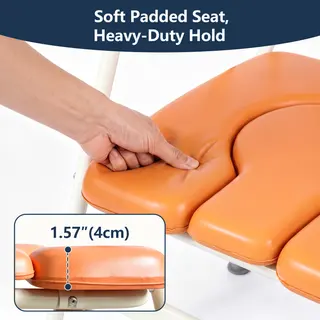
YMX6108K
Multi-angle reclining backrest, wide-stance frame, second bucket included

LM5206K
Folding shower chair with an adjustable backrest, 5-level height adjustment and a 150 kg load rating
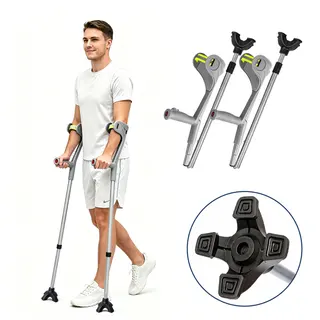
YMX4202AJ
Folding elbow crutch, 12-level height adjustment, self-standing quad base
Related notes
Price this against your market
Send the category, the market and the quantity band. We reply with material options, MOQ per SKU, lead time and the certificates your market needs.