Mobility Aid Returns: Five Design Details Buyers Miss
Most mobility aid returns are fit failures, not defects. Five design specs to check on the sheet before you place the order.
What this note covers
Most mobility aid returns are fit failures, not defects. Five design specs to check on the sheet before you place the order.
Covers: mobility aid return rate · assistive device returns · shower chair seat height · commode chair seat width · toilet safety rail dimensions · bariatric mobility aid load rating
Key figures at a glance
If you are trying to work out why mobility aid return rates stay high in a category where nobody is making obviously bad products, the answer is usually on the specification sheet rather than in the factory. Returns in commode chairs, shower chairs, toilet safety rails, canes and walkers are dominated by fit and expectation: a seat band that does not bracket the user, a seat that is 4 cm too narrow, an armrest that stops the toilet lid from opening, a foot pad that slides on a wet tile. None of those are defects. All of them are decisions taken at the purchase order stage, and all of them come back as freight, inspection time and a credit note eight weeks later.
The factory side sees these returns from the other end. The complaint that arrives is almost never “the frame bent”. It is “the customer says it is too low”, “it does not fit our toilet”, “it slides”. Those sentences are specifications that were never agreed, not quality that was lost. Below are the five details where that happens most often, with the actual numbers from our range so you can see what a usable specification looks like.
Seat height: the adjustment band is the product, not the number
A listing that says “height adjustable” has told you nothing. What matters is the band, and whether the band matches the population you sell to.
Two of our shower chairs illustrate the point. The LM3200 wood-grain shower chair adjusts the seat from 53.5 cm to 60 cm, with overall height running 73.5–86.5 cm. The LM5206K folding shower chair adjusts from 63.4 cm to 72.2 cm, overall 80.3–89.5 cm. Both are five-level, both sit on stainless main frames rated to 150 kg, both are legitimate products. But a buyer who treats them as interchangeable will generate returns on one of them, because the second chair is not a taller version of the first — it serves a shorter or taller user population depending on which direction you look at it.
The practical rule: find the seat height the user already sits at without discomfort, then pick the model whose entire band brackets that number with room above and below. If the target number sits at the very top of a model’s band, the chair has no headroom left for the cushion compressing, the floor mat, or the user’s own posture changing over a year. Buyers who choose by “closest number” instead of “band contains the number with margin” are the ones who see the same SKU returned twice.
For walkers the equivalent number is not seat height but handgrip height relative to the user’s stature, and it is usually quoted as a user-height range rather than a frame dimension. The LM2001-S walker covers 761–969 mm across eight settings and is specified for users 158–198 cm. That is a much easier specification to check against a customer list than a millimetre figure, because the retailer already knows the customer’s height.
Seat width and depth: where “too small” actually comes from
Seat width is the second filter, and it fails in both directions. Too narrow and the user cannot sit centred; too wide and the arms have nothing to push against when standing.
Concrete example: the YMX5109-S heavy-duty shower chair uses an HDPE seat board of 43 × 33 cm, on a stainless frame with a 1.2 mm wall rated to 350 kg. That 43 cm figure is a real selling point for a wide user and a real return driver for a small one, because a 43 cm seat on a 45 cm wide person leaves no room for a towel, a transfer board or a seated shower chair cushion.
Depth matters as much and is discussed far less. A seat that is too deep pushes the front edge into the back of the knee, which is uncomfortable in a shower chair and genuinely unsafe in a commode chair, because the user slides forward to relieve the pressure and then has to push back up. Depth is also the dimension most often missing from a listing, along with the distance from the seat front edge to the bucket opening.
When you compare suppliers, ask for seat width, seat depth and the bucket opening dimensions as three separate numbers. A catalogue that gives only “wide seat” is telling you the marketing team wrote the spec, not the engineering team.
Armrests and clearance: the specification nobody photographs
Armrest height is the single most under-specified dimension in this category, and it is where toilet-related returns concentrate.
Two numbers do the work. First, the armrest height band. The LM2012-S forearm walker runs an arm support adjustable from 32.9 cm to 37.9 cm, which is the range that has to contain the user’s forearm resting height, not their standing elbow height. Second, the clearance: can the toilet lid open with the rail in place, and can the user transfer sideways without dismantling anything.
On toilet safety rails this becomes a geometry problem. The YMX1106-S toilet safety rail adjusts 18.2”–28.1” in height across five settings and 23.4”–25” in width, with the width tolerance stated as within 0.01”. That tolerance line is the one worth reading twice. A rail that clamps “about right” will fit the first toilet in the showroom and not the second one in the customer’s bathroom, because the mounting points differ by a centimetre and the clamp has no adjustment left.
The other clearance that generates returns is the lid. A rail that holds the lid open is a feature; a rail that traps the lid is a return, every time, and it will not appear in a product photo. Ask the supplier to show the lid open with the rail mounted, and ask what happens to the bucket or the bedpan clearance on a commode chair when the backrest is reclined.
Foot pads and floor surfaces: the “it slips” return
“It slips” is the return reason that buyers most often attribute to quality and suppliers most often attribute to user error. In practice it is a material and geometry decision.
Three details separate a foot pad that holds from one that slides:
- Material. TPR and rubber behave differently on wet tile, and both behave differently again on vinyl flooring in a care home. The LM3200 uses sloped rubber foot pads; the YMX5109-S uses thickened TPR pads; the LM2001-S walker uses thickened TPR specified for wood flooring, ceramic tile, gravel and lawn. Those are three different answers to three different floor populations.
- Contact geometry. A sloped pad spreads load and resists a rolling motion; a flat pad resists sliding but not tipping. Which one you need depends on whether the chair is used on a level bathroom floor or on a slight fall towards a drain.
- Number of contact points. On a toilet rail, four pads under the legs is not the same as eight load-bearing points. The YMX1106-S is built around eight contact points on a 304 steel frame with a paint coating and a 500 lb rating. The YMX113G-S uses 360° clamps with a 400 lb rating. More contact points generally means less rocking, which is the failure mode that reads to a user as “unstable”.
If you sell into care homes rather than private bathrooms, the floor is usually sealed vinyl or epoxy, not tile, and the failure mode changes from sliding to scuffing. Ask for the pad compound, not just “non-slip”.
Load rating versus the person in front of you
Load ratings in this category are quoted as absolutes — 150 kg, 300 lb, 350 kg, 500 lb — and buyers routinely treat them as a pass or fail against the user’s weight. That reading is too simple, and it is expensive in both directions.
A static rating describes a frame holding a mass. It does not automatically describe what happens when a 120 kg user sits down from standing forty times a day, or when the chair is dragged sideways across a threshold with the user still on it. The number is still useful, but only alongside two questions: what was tested, and what does the rating cover?
Our range shows how different the answers can be for products that look similar. The YMX5110-S-SRB shower chair is rated to 300 lb with double X-bar locks. The YMX5109-S is rated to 350 kg on a 1.2 mm stainless wall. The YMX6301KB extra-wide bariatric commode chair uses an extra-strong triangular frame with the same SecureLock geometry as the standard model, which is what allows the wider seat without the frame racking. And the LM4702TZD carbon fibre cane with seat uses a 1.2 mm tube wall where the usual figure in this price band is 0.8 mm, for a 100 kg rating.
For bariatric lines specifically, the return driver is rarely the frame. It is the seat width, the bucket capacity, and whether the chair still fits through the bathroom door at the wider stance. A 350 kg frame that cannot enter the room is not a solution.
Hinges, buckets and the second-user failure
The last group of returns happens after the product has worked once. A folding mechanism that develops play after a month, a bucket that is difficult to remove and clip back, a backrest that no longer locks in the reclined position.
The YMX6108K flip-back commode chair is a useful case because three of its features are direct answers to that failure pattern: a wide-stance frame with SecureLock to stop the wobble that develops at the hinge, an adaptive backrest that flips away rather than folding under load, and a second bucket included so that one can be clean while the other is in use. The second bucket is not a giveaway. It removes the daily remove-and-rinse cycle that wears out the clip on single-bucket models.
When you evaluate a folding chair, ask three things: what the hinge is made of, how many cycles it is tested for, and whether the locking mechanism is accessible for cleaning. A hinge that cannot be cleaned in a bathroom environment will fail, and it will fail inside the warranty period.
What to put on the sheet before you place the order
The framework that keeps returns down is short, and none of it requires new tooling.
- Profile the user before the model. Height, seated height, weight, bathroom dimensions, door width. Match models against the profile, not the other way round.
- Demand bands, not adjectives. Every adjustment should be quoted as a numeric range with a stated number of settings. “Adjustable” is not a specification.
- Collect the four missing dimensions. Seat width, seat depth, bucket opening, and armrest height band. If a supplier cannot produce them, that is the answer.
- Ask what the load rating covers. Static load and repeated sit-down are different tests; get the method in writing alongside the number.
- Test one size band before the container. One sample per band, in front of the actual end user, for an afternoon. That is cheaper than one returned pallet.
None of this is exotic. It is the difference between a purchase order written against a marketing page and one written against a specification. In a category where the products are fundamentally similar, that difference is where the margin sits — and where the returns do not.
If you want the full dimension set for any model in the range, the commode chair category and its sibling categories link to each model sheet, and the MOQ and pricing page covers how mixed-model orders are counted. Certificates, including ISO 13485 8623138319 and ISO 9001 8629985173, both valid to 18 June 2028, are listed with their scope on the certifications page — a scope line you can check is worth more than a logo you cannot.
Frequently asked questions
- Why do so many mobility aids get returned?
- In this category the common causes are fit and expectation, not breakage: a seat height band that does not match the user, a seat too narrow or too short front-to-back, armrests that block the toilet lid or the transfer, foot pads that slide on a wet floor, and a load rating chosen for the average user instead of the actual one. Each of those is decided on the specification sheet, months before the carton is opened.
- What seat height should a shower chair be?
- There is no single number. On our LM3200 the seat adjusts from 53.5 cm to 60 cm; on the LM5206K it runs 63.4 cm to 72.2 cm. The second chair is not a taller version of the first — it serves a different user population. Measure the seat height the user already sits at comfortably, then pick the model whose whole band brackets that number with room above and below.
- Is a 150 kg rating enough for a heavier user?
- It depends on what the 150 kg covers and how it was tested. A 150 kg static rating is not the same as a 150 kg user sitting down repeatedly from standing. For heavier users, look for a frame built for it — the YMX6301KB bariatric commode uses a triangular frame, and the YMX5109-S shower chair is rated to 350 kg with a 1.2 mm stainless wall. Ask for the test method, not just the number.
- What do I need to measure before ordering toilet safety rails?
- Four things: the toilet type (square, suspended, V-shape or round), the height from floor to the top of the seat, the width across the mounting points, and whether the lid must stay usable. The YMX1106-S covers 18.2"–28.1" in height across five settings and 23.4"–25" in width, with a stated tolerance within 0.01" — that tolerance is worth asking about, because a rail that clamps "about right" is the one that comes back.
What to fix before you request a quote
Return rates in mobility aids are set by the specification sheet, not the factory. Check the adjustment band, the seat dimensions, the armrest clearance, the foot pad material and the test method behind the load rating before you sign the PO.
How to apply this to your order
- Write the user profile first — height, seated height, weight, bathroom layout — then match models against it. Do not start from the model list.
- For every model you shortlist, ask for the full adjustment band, not a single "adjustable" claim, and confirm the band brackets your user with margin on both ends.
- Ask how the load rating was tested and what it covers. Static load, repeated sit-down and dynamic impact give three different numbers for the same frame.
- Before the first container, order one sample per size band and put it in front of the actual end user. One afternoon of that catches what a spec sheet cannot.
Where these figures come from
- Product specification sheets, LM3200, LM5206K, YMX5109-S, YMX1106-S, YMX6108K, YMX6301KB Published on each model page and the category pages of jindarehabcare.com checked Retrieved 19 Nov 2026
- ISO 13485 certificate 8623138319, ISO 9001 certificate 8629985173 Certifications page, verifiable with the issuing body checked Valid to 18 Jun 2028
- Minimum order and lead time Site facts: $2,000 order value, models mixable; 7–10 days production checked As published Nov 2026
Models this note applies to
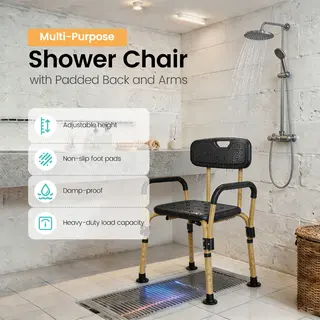
LM3200
Multi-purpose shower chair with a wood-grain finish, padded back and arms, tool-free height adjustment and a 150 kg load rating
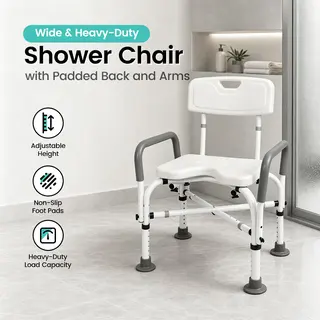
YMX5109-S
Wide heavy-duty shower chair with padded back and arms, 5-level height adjustment and a 350 kg load rating
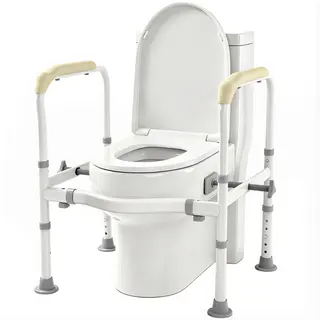
YMX1106-S
Height- and width-adjustable rail on a 304 stainless frame, 500 lb rated, 8 load-bearing points
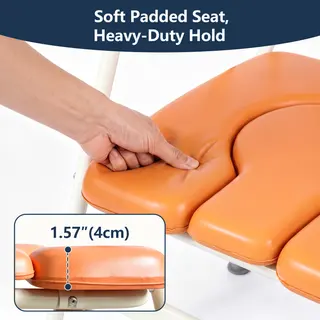
YMX6108K
Multi-angle reclining backrest, wide-stance frame, second bucket included
Related notes
Price this against your market
Send the category, the market and the quantity band. We reply with material options, MOQ per SKU, lead time and the certificates your market needs.