Toilet Safety Rail Fit: Three Dimensions That Decide Returns
Most toilet rail returns are fit failures, not quality ones. Rim height, tank geometry and hinge spread decide whether the clamp closes.
What this note covers
Most toilet rail returns are fit failures, not quality ones. Rim height, tank geometry and hinge spread decide whether the clamp closes.
Covers: toilet safety rail dimensions · toilet safety frame fit · will a toilet safety rail fit my toilet · toilet safety rail manufacturer China · toilet rail wholesale supplier
Key figures at a glance
If you are sourcing toilet safety rails, the number that decides your return rate is not the capacity printed on the box. It is whether the clamp closes on the toilet your customer already owns. Three dimensions settle that question — rim height, tank geometry, and seat hinge layout — and all three are measurable before you place an order. This article is about how to measure them, what a supplier’s “fits 99% of toilets” claim actually covers, and how to catch a fit failure with samples instead of with returns.
The three measurements that decide fit
A clamp-on toilet rail is a frame that hangs off something. In almost every design, that something is the toilet tank, the wall behind it, or the seat hinge bolts. Which of the three it attaches to determines which dimension can fail.
The rail industry tends to talk about adjustability as if it were one number. It is three separate ranges, and a product can be generous in one and hopeless in another:
- Vertical range — how far the handle sits above the rim, and how much of that range is real adjustment rather than assembly tolerance.
- Horizontal clamping range — how wide the clamp jaw opens, and how much flat surface it needs on each side.
- Mounting footprint — whether the frame lands on the floor, on the bowl, or on the hinge bolts, and what each of those requires to be unobstructed.
A buyer who specifies all three gets a rail that installs. A buyer who specifies only the first gets a rail that arrives, fits half the customer base, and generates the kind of review that is hard to answer: “did not fit my toilet.”
Dimension one: rim height sets the handle band
The handle has to sit where a seated user can push down on it without standing first. The reference band is well established: the 2010 ADA Standards place grab bars between 33 in and 36 in above the finished floor (§609.4). That band is not a marketing preference — it is the geometry of a seated person’s reach.
The problem is that a toilet bowl is not a fixed reference point. A standard residential bowl rim usually sits around 15 in off the floor, and a comfort-height bowl adds roughly 2 in on top of that. A rail that clamps to the tank and hangs its handle at a fixed offset above the rim therefore lands lower on a standard bowl than on a comfort-height one. If your market sells both — and the US market does, with comfort height now common in new builds and remodels — a single fixed-offset rail will be correct on one and marginal on the other.
This is why the height adjustment on a rail matters more than the marketing suggests. It is not there to suit tall and short users. It is there to absorb the difference between bowl heights in the same market, and to let an installer land the handle inside the 33–36 in band without changing the product.
Ask your supplier for the adjustment range in millimeters and the number of locked positions. “Adjustable height” without numbers tells you nothing. The toilet safety rails range we build runs width- and height-adjustable frames with five or more locked positions depending on model, and the specification sheet states the range rather than the word.
Dimension two: the tank is not a flat wall
The clamp is the part that fails. It needs a surface with enough flat area and enough rigidity that tightening the jaw does not simply squeeze the plastic.
Three tank layouts break a clamp designed for a conventional two-piece toilet:
- Skirted and one-piece pans. The tank shell is often rounded at the shoulder, and there is no separate tank lip for the jaw to sit under. A clamp sized for a square-shouldered two-piece tank either slips up the curve or grips on a few millimeters of contact.
- Concealed cisterns. Standard in much of the UK and Europe: there is no visible tank at all, only a flush plate in a tiled wall. A clamp-on rail has nothing to clamp. This is the single most common reason a US-market rail fails in a European bathroom, and it is not a quality problem — it is a category mismatch.
- Back-to-wall and close-coupled pans with a narrow ledge. The gap between the bowl and the wall can be too small for the frame to pass behind the seat, which is where the mounting plate has to go.
The practical consequence for a wholesaler is that “fits most toilets” needs a definition attached. In our own line the phrase appears as locks in at any angle, fits 99% of toilets — the honest reading of that sentence is that the 360° clamp rotates to reach a workable angle on the great majority of two-piece installations, not that the rail is universal. Any supplier who will not put a number next to the percentage is telling you the percentage is decorative.
Dimension three: hinge spread and bowl width
Rails that bolt through the seat hinge holes are the cheapest to make and the fussiest to fit, because they borrow the toilet’s own mounting points.
On the US two-piece bowls that dominate the category, hinge bolts commonly sit on a 5½ in center-to-center spread. That figure is a convention, not a global standard: one-piece pans, European bowls, and toilets fitted with a washlet seat all vary, and a washlet seat often occupies the bolt holes the rail wanted. A bolt-through rail also raises a second question the buyer rarely asks — whether the original seat can go back on top of the mounting plate, and whether the lid still closes flat.
Bowl width matters for the same reason. A frame that straddles the bowl needs clearance on both sides; a narrow bathroom with a vanity against the bowl has no clearance on one side, and the rail ends up installed at an angle that shortens its effective handle length.
This is where the widest setting becomes the weak case. A rail tested at its narrowest adjustment is tested in its strongest geometry. Ask for the capacity figure and the setting it was measured at, and treat an unqualified capacity number as a claim rather than a test result.
What “fits 99% of toilets” should mean on a spec sheet
A percentage is not a specification. It cannot be checked, it cannot be quoted in a tender response, and it cannot be defended when a customer sends a photo of a bathroom it does not fit.
What can be specified is a set of ranges. Five fields turn a vague claim into something an installer can verify with a tape measure before opening the carton:
| Field | What it must state | Why it fails in the field |
|---|---|---|
| Handle height range | mm above rim, and number of locked positions | Fixed offset misses comfort-height bowls |
| Clamp jaw opening | mm minimum to maximum | Rounded tank shoulders need more jaw travel |
| Clamp contact depth | mm of flat surface required | Skirted pans give almost none |
| Mounting type | clamp-on, floor-standing, or hinge-bolt | Concealed cisterns eliminate clamp-on entirely |
| Tested capacity | kg or lb, at which adjustment setting | Widest setting is the weak case |
The same discipline applies to material. The frame in this category is either stainless steel or a coated steel. Coated and plated steel rusts at the clamp and at the weld, in a room that is wet and chemically cleaned several times a week — a failure that shows up in month eight, after the reviews are written. Material choice is a fit question in disguise, because a rusted clamp no longer grips.
The six measurements to put in an RFQ
Give a supplier these six numbers and the fit conversation becomes technical instead of hopeful:
- Rim height from finished floor, in mm.
- Tank width at the height the clamp grips.
- Tank depth, front face to back face, and whether the back face is flat.
- Bowl width across the outside at the widest point.
- Seat hinge bolt spacing, center to center.
- Distance from hinge bolts to the back wall.
Add one photograph taken from the side at seat height, and one of the tank from above. In our experience most fit disputes are settled by those two images before any sample ships.
How to catch a fit failure with samples, not returns
A sample order is only useful if it is installed. Three tests, run in three different bathrooms, will find the problems a spec sheet cannot:
- Standard two-piece toilet. Confirms the base case and gives you an install time you can quote to customers.
- Skirted or one-piece pan. This is where clamp jaws fail. If the jaw slips, you have found the limit of the design before you have 600 units on a pallet.
- Concealed cistern, if you sell into Europe. If the rail cannot be installed at all, the answer is a floor-standing or wall-fixed product, not a wider clamp.
Then load the rail at the widest adjustment with the clamp as tight as an average user would tighten it by hand — not as tight as a technician with a wrench can. The gap between those two is where field failures live.
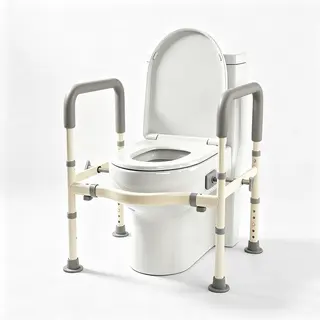
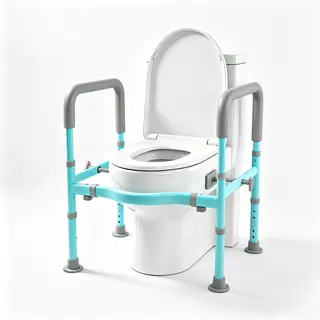
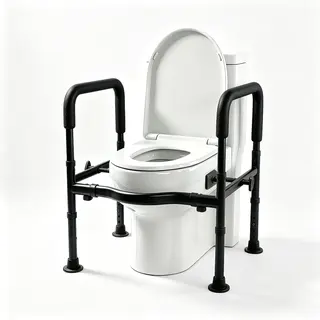
For a wholesaler testing a new category, the arithmetic is straightforward: a $2,000 order value with models mixed, produced in 7–10 days, lets you put all three finishes and a second frame style into three real bathrooms before you commit to a container. Our own line runs three models on one frame — YMX1103 in standard finish, YMX1104 in Tiffany and YMX1105 in all black — which means the sample set covers the finish question and the fit question in one order rather than two. The standard finish YMX1103 is the one to test first, because a fit problem shows up in geometry, not color.
What this does to your SKU count
The instinct when a category has fit problems is to carry more models. That usually makes it worse: more frames means more clamp designs, more carton sizes, more spec sheets to keep accurate, and more ways to ship the wrong one.
The better pattern is fewer frames, more coverage. One clamp design tested against the three bowl types above, offered in the finishes the market actually buys, with the adjustment ranges printed on the carton and on the product page. A buyer who can see the range decides for themselves whether it fits their bathroom, which is a better outcome than a support email and a return.
Then the compliance side, which is the other half of selling into institutional channels. For tender and care-home buyers the documents that matter carry numbers: ISO 9001 certificate 8629985173 and ISO 13485 certificate 8623138319, both valid to 18 June 2028; FDA establishment registration 3014264913, renewed 15 September 2025; CE EMC certificate FCS202503711CA01 for the walking-stick series. Full scans and issuing-body links sit on the certifications page, and the MOQ and pricing page states the order terms rather than implying them. The company background is in the trade since 2010, with this plant since 2017 — worth stating precisely, because buyers check.
The judgment framework
Before you approve a toilet rail for your range, four questions in this order:
- Which attachment does it use — tank clamp, floor-standing, or hinge bolt? That answer alone eliminates whole markets, and it should be the first line of the spec sheet.
- What are the three ranges in millimeters — height, jaw opening, mounting footprint? If the answer is a percentage, ask again.
- Was the capacity measured at the widest setting? The narrowest setting flatters every design.
- Does the frame material survive a wet, chemically cleaned bathroom for eight years — stainless, or coated steel with a rust clock running?
Answer those four and the return rate conversation stops being about luck. If you want the fit data for the three rails in our line — adjustment ranges, clamp opening, tube gauge, and the tested setting — that belongs in an email rather than a product page, and it goes out with a sample quote.
For the category demand picture behind this, the Amazon US rail data covers listing strength and stated capacities, and the riser versus rail comparison covers the buying decision that sits one step earlier.
Frequently asked questions
- Will a toilet safety rail fit any toilet?
- No, and no supplier can promise that. A clamp-on rail needs three things at once: a rim height that puts the handle inside a usable band, a tank or wall surface flat enough for the clamp jaw to bite, and a seat hinge layout that does not block the mounting plate. Skirted one-piece pans and concealed-cistern bathrooms usually fail one of the three.
- What measurements should I send a supplier before ordering?
- Send six: rim height from the floor, tank width and tank depth at the point the clamp grips, bowl width across the outside, seat hinge bolt spacing center to center, the distance from the hinge bolts to the back wall, and whether the bathroom has a concealed cistern. Photograph the bathroom from the side as well — most fit disagreements are settled by one photo.
- Why does a rail rated at 350 lb still get returned?
- Because capacity is not the failure mode. A rail that will hold 350 lb but sits 2 in too high, or clamps to a tank shoulder that flexes, is returned for the same reason a cheap one is. Capacity claims decide which listing a buyer clicks; geometry decides whether the product stays in the bathroom.
- How do I test fit before committing to a container?
- Order a mixed sample set and install it in three real bathrooms, not a showroom. One standard two-piece toilet, one skirted or one-piece pan, one bathroom with a concealed cistern if you sell into Europe. Time each install, then load the rail at its widest adjustment, which is always the weak case.
What to fix before you request a quote
Specify the rail by its adjustment range in millimeters and its clamp jaw opening, not by a percentage. A percentage cannot be audited; a range can be checked against a tape measure in the customer bathroom.
How to apply this to your order
- Measure three real bathrooms: rim height, tank width and depth, bowl width, hinge spread, hinge-to-wall distance.
- Ask for the adjustment range and clamp jaw opening in millimeters, and the tested capacity at the widest setting.
- Order a mixed set across the three finishes and install in the three bathrooms you measured, timed.
- Only then set the SKU count — one frame in three finishes beats three unrelated frames in one finish each.
Where these figures come from
- 2010 ADA Standards for Accessible Design, §609.4 (grab bar position) US Department of Justice checked 2010, as amended
- Jinda product data, toilet safety rail line jindarehabcare.com checked 2026
Models this note applies to
Related notes
Price this against your market
Send the category, the market and the quantity band. We reply with material options, MOQ per SKU, lead time and the certificates your market needs.