Commode Chair Load Testing: Which Report Actually Proves It
A 150 kg label can come from a five-second static push or a full cycle test. Here is the report language that separates the two.
What this note covers
A 150 kg label can come from a five-second static push or a full cycle test. Here is the report language that separates the two.
Covers: commode chair load testing · commode chair weight capacity · commode chair test report · bariatric commode chair weight limit · commode chair manufacturer China
Key figures at a glance
If you are sourcing commode chairs, “commode chair load testing” is the phrase that separates a real capacity claim from a printed number. Almost every supplier will tell you the chair holds 150 kg, 300 lb or 800 lb. Very few will tell you how that number was produced — whether it came from a five-second static push or a full cyclic run, whether it was measured at the seat centre or at the height-adjustment hole, and whether the frame was at its highest setting or its lowest. Those three details decide whether the rating survives a real bathroom for eight years or fails in month seven.
This is a buyer’s guide to the test itself: the two test families, where the load has to be applied, what a usable report contains, and how to audit a claim with one sample instead of a container.
Static load and cyclic load are two different claims wearing one number
A static strength test does one thing: it applies a load larger than the rated capacity to the product, holds it for a dwell time, releases it, and then measures whether the frame came back. The important output is not “it did not break”. It is permanent deformation — how many millimetres the tube, the seat pan or the leg splay moved and stayed moved. A chair that survives 200 kg for ten seconds but bends 8 mm at the leg joint has passed the test and failed the product.
A fatigue or cyclic test does the opposite thing over time. It applies and releases a load for thousands of cycles and looks for cracks where stress concentrates: welds at the leg-to-seat junction, the hinge of a flip-back backrest, the holes in a telescoping leg. This is the test that maps onto how the product is actually used. A commode chair in a care home is not loaded once; it is loaded perhaps fifteen times a day, which is roughly 5,500 load events a year, and a sit-down is not a gentle event — the peak force as a user drops into the seat exceeds their body mass.
So when a supplier says “tested to 150 kg”, the only useful follow-up is: static, cyclic, or both? A static-only claim covers the first minute of the product’s life. A cyclic claim covers the part of the life where you get the warranty email.
Where the load is applied decides what the number is worth
Most capacity failures do not happen in the middle of a tube. They happen at the point where the frame is adjustable, because an adjustment means a hole, a pin, or a sliding fit — and every one of those is a stress riser.
Three places to insist on:
- The highest and widest leg setting. A telescoping leg is a cantilever. At maximum extension the lever arm is longest, so the bending moment at the joint is highest. A rating measured at the lowest setting is not the rating your customer will experience.
- The seat pan edge, not the seat centre. Loading the centre of a moulded pan tests the pan. Loading the front edge tests the pan, the front rail and the leg joints at once, which is where a user actually puts their weight when sitting down or standing up.
- The backrest hinge, on a flip-back model. A flip-back commode has a hinge that carries upper-body load in one direction and nothing in the other. It needs its own check, and it is the first part to develop play.
Our own line illustrates how the structure changes with the number rather than the label. The standard folding commode, YMX6108K, and the flip-back YMX6109K share a frame family. The extra-wide bariatric frame, YMX6301K, is rated to 800 lb — 363 kg — and it is a different structure: wider pan, heavier tube, a reinforced triangular frame at the leg junctions. The rating went up because the steel changed, not because the print changed. The same logic runs across the shower chair range, where the standard frames sit at 150 kg and the wide heavy-duty YMX5109-S is rated 350 kg on a different frame and a different seat board.
What a commode chair test report has to print
A one-page test report is enough, if it has these eight lines. If any is missing, the number on your packaging is a claim rather than a measurement.
- Product identification — model, variant and, for a batch claim, the production batch or serial range. A report for “commode chair, general” is not evidence for the SKU you are importing.
- The standard and the clause — not “international standard”, the actual designation and the specific test clause.
- Rated capacity and actual test load, with the factor expressed explicitly. If the report says the load was 150 kg on a 150 kg-rated chair, the chair was not tested above its rating.
- The application point, with a fixture drawing or photograph. A test at the seat centre and a test at the front edge are different tests.
- The adjustment setting used — highest, widest, or both.
- Dwell time for static, cycle count and cycle rate for fatigue.
- Pass/fail plus measured permanent deformation, in millimetres, per test point.
- The laboratory, its accreditation, and the date — plus the page count, so you can tell whether you have the summary or the whole document.
Most suppliers send a certificate of compliance rather than test data. A certificate says the product conforms; only a report says what was done to it.
Which standards actually apply to a commode chair
This is where files get padded with impressive-looking document numbers that belong to a different product family.
A commode chair is a hygiene-support product. The family that governs it is ISO 17966:2016, assistive products for personal hygiene that support users, which covers shower chairs, commodes and bath boards, and sets out static strength, fatigue and stability tests for that use. In the EU, EN 12182 supplies the general assistive-product requirements layered under it.
Two other standards get quoted constantly and usually do not apply:
- ISO 11199 covers walking aids manipulated by both arms — canes, crutches, rollators. A commode chair is not a walking aid, even if the user leans on it on the way up.
- ISO 7176-8 covers static, impact and fatigue strength for wheelchairs. It applies only if the product really is a wheeled chair. A fixed commode chair with rubber feet is not in that scope.
A report citing the wrong family is worse than no report, because it tells you the file was assembled by someone who has not read it.
The metric-to-imperial trap that creates returns
Capacity is where a packaging decision turns into a customer complaint. The conversions are simple and constantly misused:
- 150 kg is 330 lb. A US listing that reads “300 lb” is quoting below its metric rating — safe, but you are leaving capacity on the table.
- 350 lb is 158.8 kg. A chair rated 150 kg cannot honestly be sold as 350 lb.
- 300 lb is 136 kg. If the report says 150 kg and the carton says 300 lb, the carton is under-claiming, which is fine — but check that the same chair is not also listed at 350 lb somewhere else in your channel.
- 800 lb is 362.9 kg.
The failure pattern is a listing that rounds up because the number reads better. Rounding up past the tested figure is the one direction that produces a return, a safety incident and, in an institutional tender, a compliance finding.
How to audit a claim with one sample
You do not need a lab to catch an exaggerated rating. One sample and one afternoon will do it.
Load the chair at the highest leg setting with weight at the seat front edge, and hold it. Then measure the leg splay before and after — a tape measure between the front feet, taken twice, tells you whether the frame is elastic or plastic. Then sit and stand on it forty times in a row and re-measure. A frame that regains its geometry is doing what a cyclic test expects. A frame that walks outward by 5 mm in forty cycles will not survive a year.
Then check the parts that carry load but never appear in a capacity claim: the bucket support rails under the seat, the seat pan’s moulded ribs, and the rubber feet. On a bariatric chair the bucket is the first thing to fail, not the frame — which is why a heavier frame with a standard bucket is a half-finished product.
For procurement documentation, the numbers that survive an audit are the ones with an identifier attached. On our file: ISO 9001 certificate 8629985173 and ISO 13485 certificate 8623138319, both valid to 18 June 2028; FDA establishment registration 3014264913, renewed 15 September 2025; CE EMC certificate FCS202503711CA01 for the walking-stick series. Scans and the issuing-body lookup links sit on the certifications page, and the order terms — a $2,000 minimum with models mixable, 7–10 days production — are stated on the MOQ and pricing page rather than implied. Company background, for the record: in the trade since 2010, this plant since 2017.
The judgment framework
Four questions, in this order, before you approve a capacity claim for your range:
- Static, cyclic, or both — and at which adjustment setting? If the answer is “both, at maximum extension”, you are talking to someone who has read the report.
- What is the measured permanent deformation? A pass with 8 mm of set is a different product from a pass with 0.5 mm.
- Does the report’s model and variant match the SKU? Family-level reports are the most common way a good test gets attached to the wrong product.
- Does the listing quote at or below the tested figure, in the units your market reads? This is the cheapest fix in the whole chain and the most frequently skipped.
Answer those four and the capacity number stops being a marketing decision and becomes a specification. The wider context — how the frame, seat and bucket interact on a heavy-duty model — is in the bariatric commode specification guide, the seat and bucket trade-offs are covered in the seat and bucket guide, and the document set a tender panel actually opens is in the tender documentation breakdown. For the quality-system side of the same question, the ISO 13485 versus ISO 9001 comparison explains why one of those two certificates is the one a test report has to live under.
Frequently asked questions
- What does a 300 lb commode chair rating actually mean?
- It means one of two very different things, and the label does not say which. It can mean the frame survived a single static load of that mass for a few seconds, or that it survived a defined number of load cycles at that mass. A static pass proves the chair does not collapse the first time someone sits down. A cyclic pass proves the weld does not crack in month eight. Ask which one, then ask for the number of cycles.
- How is commode chair weight capacity tested?
- Two test families. Static strength applies a load greater than the rated capacity to the seat and frame, holds it for a defined dwell time, then measures permanent deformation after the load comes off. Fatigue or cyclic testing applies and releases a load for thousands of cycles and checks for cracks at welds, hinge points and height-adjustment holes. A credible report states both, with the load factor, dwell time or cycle count printed on it.
- Which ISO standard covers a commode chair?
- A commode chair is a hygiene-support product, so the relevant family is ISO 17966, assistive products for personal hygiene that support users, together with EN 12182 for general assistive-product requirements in the EU. ISO 11199 covers walking aids and ISO 7176-8 covers wheelchairs — those apply only if the product is actually a walker or a wheeled chair. A report quoting the wrong family is a red flag, not a bonus.
- Why do bariatric commode chairs cost so much more?
- Because the rating is not a label, it is a different structure. Going from 150 kg to 363 kg means a wider seat pan, thicker tube wall, a different weld schedule at the leg joints, a stronger bucket support and a carton that survives the freight. If a supplier sells you an 800 lb frame at the standard frame price, the frame did not change — only the printed number did.
What to fix before you request a quote
Judge the claim by the report, not the number. A capacity figure is only worth what its test method says: which standard, which load factor, which application point, and whether it was static or cyclic. Ask for those four lines in writing and most of the ambiguity disappears.
How to apply this to your order
- Ask for the test report, not the spec sheet, and check that the model and variant on the report match the SKU you are buying.
- Confirm static and cyclic were both run, and that both were run at the highest and widest adjustment setting.
- Convert the rating to the units your market reads, and make sure the listing does not quote above the tested figure.
- Install one sample and load it at the extreme adjustment before committing to a container.
Where these figures come from
- ISO 17966:2016 — Assistive products for personal hygiene that support users: requirements and test methods International Organization for Standardization checked 2016
- ISO 7176-8:2014 — Wheelchairs, Part 8: static, impact and fatigue strengths International Organization for Standardization checked 2014
- EN 12182:2012 — Assistive products for persons with disability: general requirements and test methods CEN checked 2012
Models this note applies to
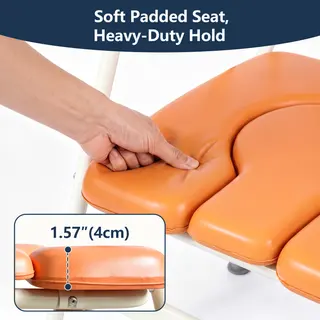
YMX6108K
Multi-angle reclining backrest, wide-stance frame, second bucket included
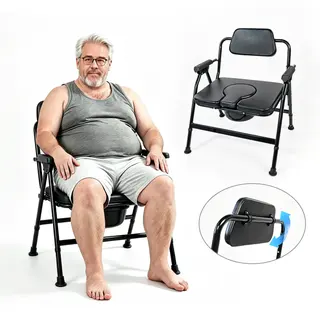
YMX6301KB
Extra-strong triangular frame, extra-wide seat, adaptive backrest
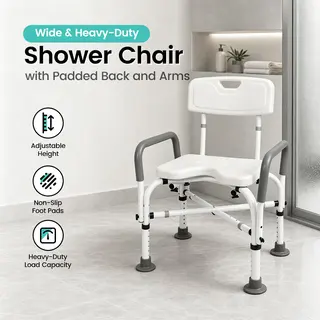
YMX5109-S
Wide heavy-duty shower chair with padded back and arms, 5-level height adjustment and a 350 kg load rating
Related notes
Price this against your market
Send the category, the market and the quantity band. We reply with material options, MOQ per SKU, lead time and the certificates your market needs.